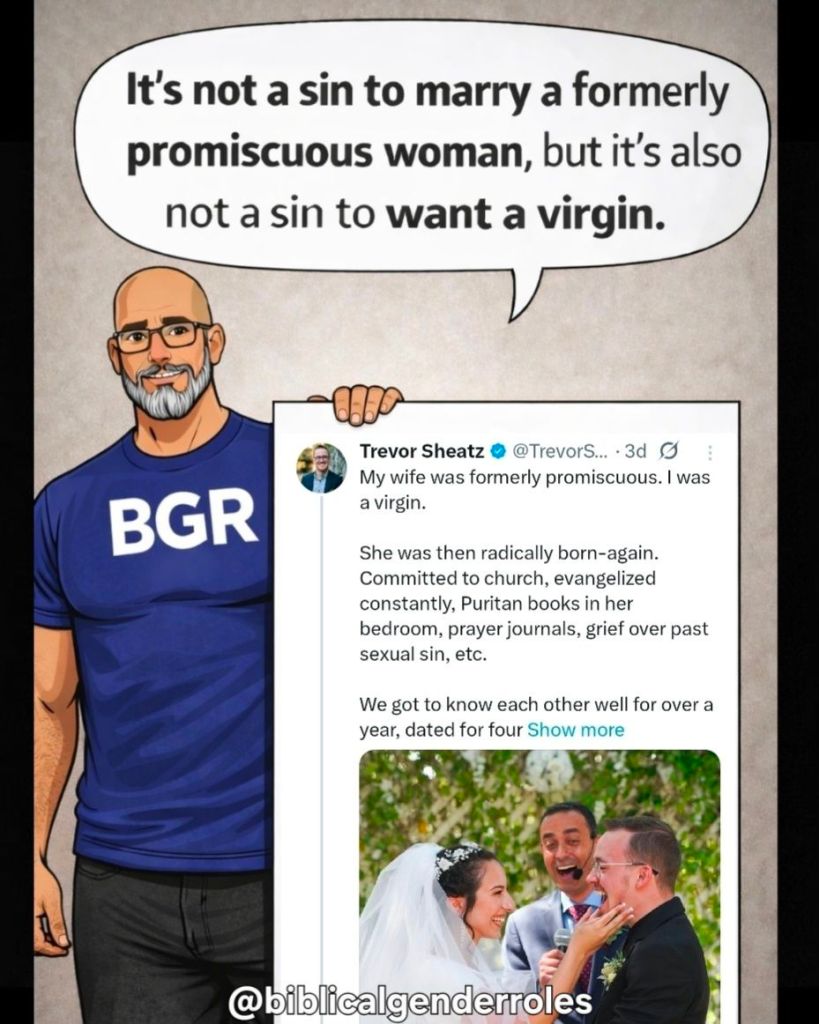
In recent days, a viral post has been circulating online arguing that Christian men place too much emphasis on a woman’s virginity when choosing a wife. The argument is framed around grace—that a woman’s past sexual sin, if repented of, should not disqualify her from marriage.
This discussion was sparked by a viral post on X that has generated widespread debate among Christians on the issue of virginity, repentance, and marriage:
There is truth in that.
But like many modern takes on biblical issues, the argument is incomplete. It presents a partial truth and then subtly turns that truth into a weapon against another biblical principle.
The result is confusion.
So let’s bring clarity.
Grace Is Real—and It Must Be Affirmed
The Bible is absolutely clear that no one is beyond redemption.
No past sin—sexual or otherwise—places a person outside the reach of God’s grace.
“If we confess our sins, he is faithful and just to forgive us our sins, and to cleanse us from all unrighteousness.” (1 John 1:9, KJV)
This includes sexual sin.
A woman who has lived a promiscuous life but later repents and turns to Christ is not permanently stained in the eyes of God. She is forgiven. She is cleansed. She is restored spiritually.
That is not negotiable. That is the Gospel.
And any man who refuses to acknowledge the power of God’s forgiveness is not thinking biblically.
But Grace Does Not Erase Earthly Consequences
At the same time, Scripture never teaches that forgiveness removes all temporal consequences of sin.
David was forgiven for his sin with Bathsheba.
Yet the consequences remained.
Sexual sin, like many other sins, can leave real-world effects—physically, emotionally, and relationally.
This is not cruelty.
It is reality.
And wisdom requires that reality be acknowledged, not ignored.
Virginity Still Matters in Scripture
One of the greatest errors in modern Christian thinking is the attempt to act as if virginity has no meaningful value.
But the Bible does not treat it that way.
“And he shall take a wife in her virginity…” (Leviticus 21:13, KJV)
This was not presented as a trivial preference. It was a standard tied to holiness.
And in the New Testament, the concept is not discarded—it is elevated into a spiritual ideal:
“…that I may present you as a chaste virgin to Christ.” (2 Corinthians 11:2, KJV)
Notice what Paul does here.
He uses the image of a virgin to represent purity itself.
That is not accidental.
Virginity is not treated as irrelevant—it is treated as a powerful symbol of holiness, faithfulness, and unshared devotion.
The False Choice Being Presented
Modern discussions often try to force a false dilemma:
Either you believe in grace
or you value virginity.
Either you accept people’s past
or you have standards.
This is a lie.
The Bible never forces that choice.
Grace and standards are not enemies.
They coexist.
A Matter of Consistency, Not Hypocrisy
The real issue is not whether a man values virginity.
The real issue is whether he is consistent.
If a man has lived a sexually promiscuous life and later repents, then he should approach marriage with humility. He should recognize that he, too, brings a past into the relationship.
It would be hypocritical for such a man to demand a standard he himself did not meet.
But if a man has remained sexually pure…
Then there is nothing sinful, shallow, or unspiritual about him desiring the same in a wife.
That is not hypocrisy.
That is consistency.
Standards Are Not Sin
In today’s culture—even in many Christian circles—men are increasingly shamed for having standards.
Especially standards related to sexual purity.
They are told:
“Don’t prioritize that.”
“That shouldn’t matter so much.”
“You’re being unrealistic.”
But where does Scripture say that?
It doesn’t.
God values sexual purity.
So it is not wrong for men to value it.
Grace Restores—But Wisdom Still Discerns
A woman who has repented of sexual sin may very well become a godly wife.
That is true.
But it is also true that a man must exercise wisdom in choosing a spouse. Marriage is not merely about forgiveness—it is about lifelong covenant, compatibility, and stability.
Recognizing that past choices can have present effects is not a denial of grace.
It is an application of wisdom.
The Balanced Biblical View
The biblical position is not complicated, but it is often ignored:
Grace forgives the past.
Standards guide the future.
A man should not hold a woman to a higher standard than he himself has lived.
But neither should he be shamed for desiring a wife who reflects God’s design for sexual purity.
Virginity is not the only factor in choosing a wife.
But it is not a meaningless factor either.
Final Thought
The danger in many modern arguments is not what they say explicitly—but what they imply.
In trying to remove shame from past sin, they subtly introduce shame for righteous standards.
That is not biblical.
A Christian man is free to believe in grace.
And he is free to value purity.
He does not have to choose between them.
Because God never did.
 Biblical Sexology